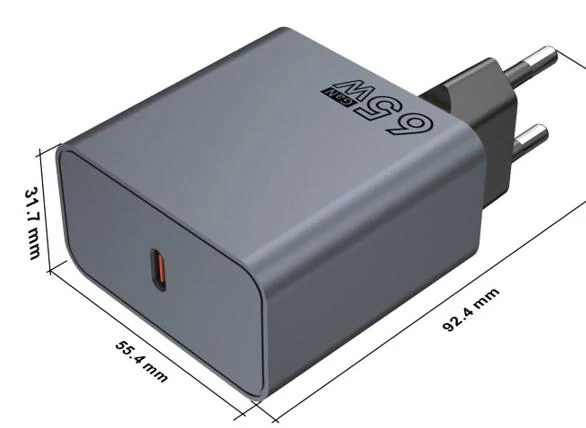
A request for a “65W GaN charger” can describe many different products: one port or several, different output profiles, different plugs and different documentation. A useful sourcing brief removes that ambiguity before price comparison begins.
Start with the product, not the GaN label
Gallium nitride (GaN) is a semiconductor technology used in charger power designs. Its presence does not, by itself, define the charger’s output distribution, device compatibility, thermal behavior, enclosure size or compliance documentation. Those details belong to the specific model and configuration.
The AmpLoom GaN product range includes documented configurations from 20W to 65W, with single- and multi-port layouts. Treat the catalog as a shortlist of starting points, then confirm the exact model against your market and order requirements.
The buyer’s key takeaway
Compare quotations only when the model, port layout, output table, plug, branding scope, packaging and required documents are sufficiently aligned. Otherwise, the lowest price may not describe the same product.
Build a core specification that can be quoted
You do not need to write an engineering document for a first inquiry. You do need to distinguish your required features from optional preferences. Use the following fields as the core of the request.
| Field | What to specify | Why it matters |
|---|---|---|
| Output | Target wattage and required output profiles, if known. | A maximum wattage alone does not define every voltage/current combination. |
| Port layout | Number and type of USB-C and/or USB-A ports. | Port count affects the product shortlist and simultaneous-use behavior. |
| Input | Input rating shown for the selected model and destination. | Do not assume every model has an identical input specification. |
| Plug | Required plug option for each destination market. | Plug options vary by model and can affect the quotation and documentation. |
| Devices | Representative phones, tablets or laptops and required protocols, if known. | Compatibility should be checked against actual devices rather than inferred from wattage. |
| Physical design | Preferred dimensions, color, finish and form factor. | These constraints help narrow suitable enclosures and customization options. |
| Documents | Destination market and documents required for your sales channel. | Available reports and certificates must be confirmed for the selected model. |
Separate “must have” from “nice to have.” For example, a fixed port layout may be essential while a particular enclosure color is negotiable. That distinction makes it easier to evaluate practical alternatives.
Clarify power per port—and power when ports are shared
For a multi-port charger, ask for the model’s output table rather than relying on the headline rating. The relevant question is not only “How many watts?” but “Which output is available on each port, under which usage condition?”
- Single-port use: confirm the maximum output and supported profiles for each port.
- Simultaneous use: confirm how output is allocated when two or more ports are connected.
- Port roles: check whether similarly shaped ports have different capabilities.
- Device fit: identify the devices you intend to support and discuss the required charging behavior.
Keep the approved output table with the quotation and sample record. It provides a clearer reference than a product title when questions arise later.
Match the plug, input and documents to the destination
Tell your sourcing partner where the charger will be sold, not merely where it will be shipped. Plug configuration, labeling and market documentation need to be considered together. If you are sourcing for more than one country, list each market rather than assuming one version covers all of them.
Available compliance documents vary by product and destination. A logo printed in a general catalog is not a substitute for checking the report or certificate associated with the exact model and configuration. Request the relevant document details during evaluation and verify their applicability before order confirmation.
This is also the right time to define rating-label language, importer information, warning text and packaging labels. Your own regulatory adviser or sales-channel requirements remain the final reference for market obligations.
Use the quotation and sample to lock the configuration
A quotation should identify the product precisely enough for both sides to understand what is being priced. Record the model reference, electrical specification, port layout, plug, finish, branding, packaging, quantity and commercial terms. Confirm which details are fixed and which remain options.
When a sample is required, evaluate the agreed configuration rather than an unspecified showroom unit. Keep the approved sample, artwork and packaging references connected to the order. If any change is made after approval, document it and decide whether another approval is needed.
Quality does not stop at sample approval. The next step is to agree production and inspection expectations; see our guide to charger quality control and eight production stages.
A concise GaN charger RFQ checklist
Before sending your inquiry, try to answer these questions:
- Which wattage range and port layout do you need?
- Which devices or charging protocols are important?
- Which destination markets and plug options apply?
- What quantity should be quoted, including any trial-order quantity?
- What logo, color, label or packaging customization is required?
- Which model-specific documents does your market or sales channel require?
- Do you need a sample before bulk production?
- What target timing or shipment destination should be considered?
If some answers are still open, mark them as open. A clear unknown is more useful than an assumed specification. You can also use our OEM/ODM charger sourcing brief template to organize the request.
Sourcing note: final electrical specifications, protocol support, availability, customization, MOQ and compliance documentation are confirmed for the selected model and order. This guide does not replace market-specific regulatory advice.